BSK Associates
  • SERVICES
    • Environmental Analysis
    • Environmental Consulting
    • Geotechnical
    • Special Inspection
    • Materials Testing
    • Geophysical 
  • MARKETS
    • Agricultural
    • Commercial & Industrial
    • Education
    • Government
    • Healthcare
    • Energy
    • Transportation
    • Water Resources
    • Solid Waste
  • ABOUT
    • Executive & Board
    • Senior Leadership
  • CAREERS
  • CONTACT
  • CLIENT CONNECT
  • Menu Menu

BSK Associates Names Weldon Elementary Its Q2 2026 Sponsorship Winner

October 14, 2026/0 Comments/in News/by Mikael Kourinian

Fresno, Calif. — BSK Associates has named the Weldon Elementary School sports program as the recipient of its second quarter 2026 Corporate Sponsorship award. The nomination, submitted by BSK Associate Rebecca Vance of the company’s Fresno Analytical Lab, highlights the powerful role youth athletics can play in shaping young lives well beyond the scoreboard.


Vance nominated Weldon Elementary’s sports teams for the meaningful impact they had on her own son during a difficult period in his life. “The sports teams mean a lot to me as it helped my son through a rough time in his life,” Vance shared. “He made lifelong friends and had amazing mentors through the sports teams at Weldon, and even though he is older, he still goes there and watches the practices and helps where he can.”


Vance’s connection to the program didn’t end when her son moved on — it became a family tradition of giving back. As a self-described “Sports Mom,” she has spent countless hours supporting Weldon’s teams in whatever way was needed. “Whether it be holding the poles on the side of the field, getting water for the kids, or pizza parties, I was there!” Vance said.

Her story reflects exactly what BSK Associates’ Corporate Sponsorship Program was designed to celebrate: the everyday people and grassroots programs that strengthen communities from the ground up. Each quarter, BSK Associates invites employees across its network of offices to nominate a nonprofit organization, school program, or community initiative that has made a meaningful difference in their lives or the lives of others. A committee reviews the nominations and selects a winner to receive a corporate sponsorship donation, along with public recognition of the cause and the employee who brought it forward.


Weldon Elementary, located in Clovis, California, has built a reputation within its community for youth sports programs that emphasize character development alongside athletic skill. Coaches and volunteers — many of them parents like Vance — dedicate their time to mentoring students, fostering teamwork, and creating a sense of belonging that often extends well beyond a student’s years at the school. As Vance’s story illustrates, the relationships formed through these programs can leave a lasting mark, with former students returning years later to support the very teams that once supported them.

The sponsorship award from BSK Associates will help Weldon Elementary continue investing in its sports programs, ensuring more students have access to the mentorship, camaraderie, and support system that made such a difference for Vance’s family.

BSK Associates extends its congratulations to Weldon Elementary and its thanks to Rebecca Vance for sharing her family’s story and for her continued dedication to the program’s success.


About BSK Associates BSK Associates is a 100% employee-owned consulting firm providing geotechnical, engineering, environmental consulting, materials testing, special inspection and environmental analytical services. Our company was founded in 1966 and we are over 220 employees and 11 offices spanning across multiple states. We apply this knowledge and experience to meet the needs of client industries including agriculture, commercial/industrial, education, government, healthcare, energy, transportation, water resources and solid waste.

https://www.bskassociates.com/wp-content/uploads/2026/10/BLOG-POST-1200-x-628_Sponorship.jpg 628 1200 Mikael Kourinian /wp-content/uploads/2026/07/bsk-logo-60.png Mikael Kourinian2026-10-14 16:58:082026-10-14 18:47:54BSK Associates Names Weldon Elementary Its Q2 2026 Sponsorship Winner

Understanding Your Insurance Coverage

July 6, 2026/in News/by Mikael Kourinian

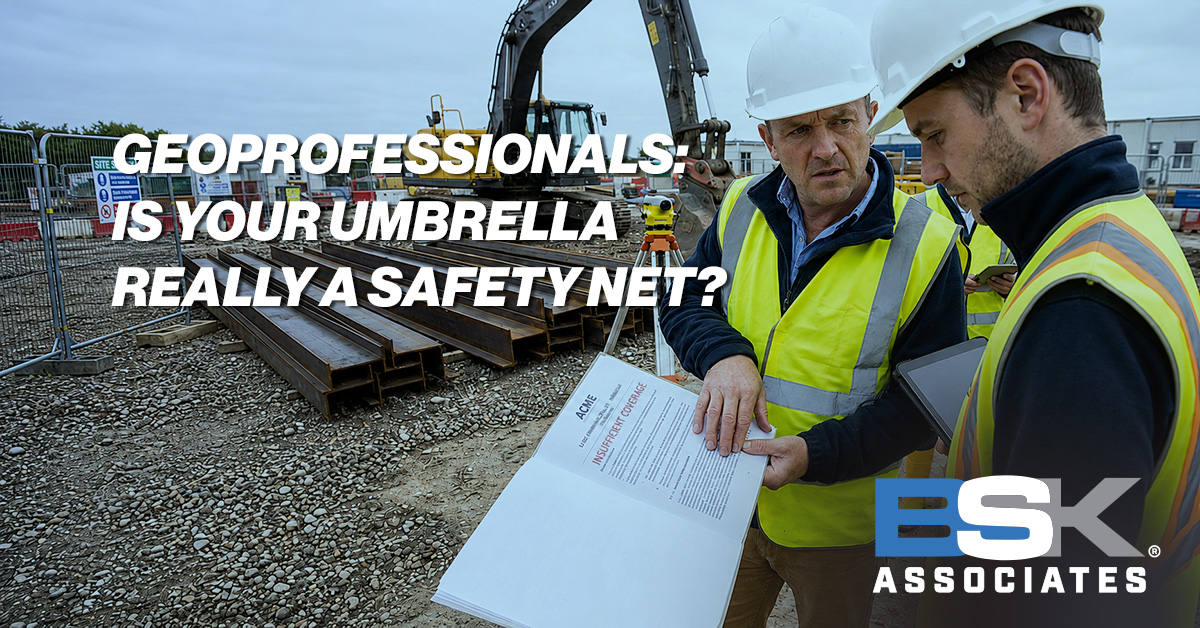
Understanding Your Insurance Coverage.  In Part 1 of this series, we walked through the contract language that can present potential exposure for a geoprofessional firm. But spotting a red flag in a contract is only the first half of the process. The other half is understanding what your insurance actually covers.  This requires a better understanding of what may or may not be covered should a requirement for your policy to kick. A hurdle to this is that Insurance policies can often be even harder to read than contracts. This article aims to make the key concepts a little more approachable.

A useful way to think about insurance coverage is to be sure you don’t think of it as a single blanket that covers everything. It is more of a collection of tools designed to address a specific type of risk. As with most things, using the wrong tool for the job, or in the case of insurance, assuming one policy stretches to cover something it was never meant to cover, is one of the most common and costly mistakes a firm can make.  Understanding Your Insurance Coverage from the outset helps prevent these missteps.

Let us work through four of the most common insurance concepts that come up in geoprofessional contracts and project negotiations.

Insurance Item 1

Most consulting firms carry several insurance policies, including general liability, commercial auto, and errors and omissions (also known as professional liability). There may be an excess or umbrella policy that serves as an addition to those policies and provides additional coverage when the limits of a primary policy are exhausted.  Figuratively, a safety net beneath the safety net.

The important thing to understand is that an excess policy can only extend coverage that already exists in the underlying policies. It doesn’t create new types of coverage on its own. If a particular risk is not covered by your primary policy, your excess policy will not cover it either, no matter how large the limit is.

In practice, this means that excess coverage can supplement your general liability, auto, and professional liability policies. But for specialized coverage types such as pollution liability and cyber liability, excess policies typically won’t apply. Those risks require their own dedicated policies. Assuming otherwise creates a gap in coverage that you need to know exists before you think you’ve got protection that you don’t.

When a contract requires high limits of coverage, you need to ensure that your excess policy actually applies to the type of coverage being requested, not just the dollar amount. A large umbrella limit means nothing if the underlying risk is not covered by the policy it is meant to increase the coverage for.

Also, for clarification, there are some differences between excess coverage and umbrella policies. Let’s dig into that for little more detail.

The Scope of Coverage for Umbrella vs Excess Policies – Help You In Understanding Your Insurance Coverage 

  1. The “Follow-Form” Rule

  • In an Excess Policy, the policy is strictly a limit-increaser. It provides additional money for claims that are already covered by your primary policy. If your primary policy excludes a claim, the excess policy will also exclude it. Think of it like putting more water into an already existing bucket.
  • In an Umbrella Policy, your limits increase, and your coverage broadens. It can cover certain types of claims that your primary policies completely exclude. Think of this as adding a second bucket of water rather than adding more water to the first bucket.
  1. The “Drop-Down” Feature

  • An Excess Policy generally does not “drop down.” If a claim isn’t covered by your primary policy, the excess policy stays out of it entirely.
  • An Umbrella Policycan “drop down” to act as your primary insurance for claims that your underlying policies don’t cover. When it does this, you usually only have to pay a relatively small out-of-pocket deductible called a Self-Insured Retention (SIR) before the Umbrella coverage kicks in.
  1. Number of Underlying Policies

  • An Excess Policy typically sits on top of just one specific underlying policy (e.g., you might have an excess policy solely for your Commercial Auto insurance).
  • An Umbrella Policy usually sits on top of multiple underlying policies at once (e.g., a single personal Umbrella policy will sit over both your Homeowners and your Personal Auto policies).

Insurance Item 2

Commercial auto insurance comes in two basic structures. The first is a split limit policy, which sets separate maximum payouts for bodily injury per person, bodily injury per accident, and property damage. You might see this written as three separate buckets, something like $1,000,000 / $2,000,000 / $500,000.

The second structure is the one most professional consulting firms carry: a combined single limit policy. Instead of three separate buckets, there is one total limit that can be applied to any combination of bodily injury and property damage arising from a single accident. If the limit is $2,000,000, the full amount is available to cover any mix of injury and damage resulting from an incident.

Combined single limit is generally considered broader and more flexible coverage, because the money goes where it is needed most, rather than being divided ahead of time. However, some clients or contracts a requirement for split limits. So, if your policy is structured as a combined single limit, you should be prepared to explain the difference, if needed.  Understanding Your Insurance Coverage in this area allows you to address those client inquiries with clarity.

It’s a good idea to be prepared and understand which structure your auto policy uses before a client asks or you respond to a contractual requirement. If a contract specifies split limit requirements, you can talk to your broker about whether your combined single limit policy satisfies the intent.  In most cases, it does, but you need to provide written confirmation.

Insurance Item 3

Pollution coverage is an area where specifics are important, and where misunderstandings are fairly common, primarily because it’s not just one thing. There are at least three distinct types, each intended for a different situation, and they are definitely not interchangeable.

Contractors pollution liability is designed for firms that are actively performing remediation, excavation, or other physical work that could disturb or release contaminants. An example would be a contractor physically digging up contaminated soil, which is exactly the kind of work this policy exists for.

Pollution legal liability covers the legal obligations of a property owner or operator for contamination that exists on or migrates from their site. This is typically purchased by property owners, developers, or businesses with environmental exposure associated with a specific location.

Professional pollution liability is the type of coverage that most geoprofessional consulting firms carry. It covers claims arising from professional services performed in connection with pollution-related work. In other words, it covers the consulting advice, assessments, and recommendations that your firm may provide, not the physical act of cleaning something up or owning a contaminated property.

The distinction on each of these pollution liability policies is critical when a client reviews your certificate of insurance. If a contract requires contractors pollution liability and your firm carries professional pollution liability, you need to know that those are not the same thing. Submitting one when the other is required can create a coverage gap that nobody notices until a claim is filed, which is way too late in the process and opens up a whole lot of problems for both your firm and you client.

Insurance Item 4

When a client asks to be named as an additional insured on your policy, they are asking for a specific legal protection: that your insurance will extend to cover them in certain situations involving your work. This is a standard and reasonable request, and most consulting firms accommodate it routinely.

The traditional way to handle this was to issue a scheduled endorsement, a specific written addition to each policy that names the client directly. Having the client and their agents listed as additionally insured on the certificate of insurance itself does not meet this requirement, the separate endorsement must be included in the COI packet. One client, one endorsement, one administrative process.

A blanket endorsement works differently. Instead of naming each additional insured individually, the blanket endorsement automatically extends additional insured status to any party that your firm is contractually required to name — without the need to process each one separately. In effect, if your contract requires you to name someone as an additional insured, the blanket endorsement takes care of it.

For busy consulting firms working across multiple projects with multiple clients, blanket endorsements are a practical and efficient solution. They reduce administrative burden and eliminate the risk of forgetting to add someone when a contract requires it. The coverage is the same — only the mechanism for delivering it is different.  Understanding Your Insurance Coverage at this level of detail helps you communicate confidently with clients about how their protection is delivered.

If a client asks whether they are covered as an additional insured, the answer under a blanket endorsement is: yes, automatically, as long as the contract requires it. Be prepared to explain this clearly. Some clients are unfamiliar with blanket endorsements and may initially expect to see their name listed explicitly on a certificate.

In addition to the common additionally insured endorsements, clients regularly request a waiver of subrogation for each of the policies. Subrogation is the legal right of the insurance company to recover any money paid out through your policy from another party. If your company truck is totaled in an accident with a client’s vehicle by no fault of your employee, the insurance company may replace your vehicle right away but then sue the client for the cost of the replacement. A waiver of subrogation protects the certificate holder, in this case the client, by preventing the insurance company from seeking subrogation. With a waiver in place for the auto policy, the insurance company would pay the claim, and all parties would go their separate ways.

One final thought worth keeping in mind is that a certificate of insurance is a summary document. It confirms that a policy exists and lists the basic limits, but it does not tell you everything about what is actually covered, what is excluded, or how the policy behaves in specific situations. If a project carries significant risk or a contract makes specific insurance demands, the certificate is the starting point, not the finish line. Your broker is the right person to confirm the details.  This why Understanding Your Insurance Coverage is vital.

The Bottom Line

Insurance is not the most exciting topic in professional consulting; we are all probably well aware of that. But Understanding Your Insurance Coverage, the basics of what you carry, what it covers, and where it stops is genuinely valuable knowledge. It helps you respond confidently when clients ask questions, spot potential gaps before they become problems, and have more productive conversations with your broker and your leadership team.

The good news is that you do not need to become an insurance expert. You just need to know enough to ask the right questions —and to recognize when the answer you are getting does not quite add up.

In Part 3 of this series, we will bring the contract and the insurance together — looking at how to raise concerns, propose alternative language, and negotiate consulting agreements with confidence, without making it feel like a confrontation.


BSK Associates

https://www.bskassociates.com/wp-content/uploads/2026/07/Article_Insurance-Coverage_BLOG-POST-1200-x-628-Insurance-Coverage.jpg 628 1200 Mikael Kourinian /wp-content/uploads/2026/07/bsk-logo-60.png Mikael Kourinian2026-07-06 06:00:392026-07-06 06:00:39Understanding Your Insurance Coverage
RCRA Appendix IX Groundwater Monitoring

RCRA Appendix IX Groundwater Monitoring: BSK Expands Services

June 19, 2026/in News/by Mikael Kourinian

RCRA Appendix IX Groundwater Monitoring: BSK Associates Expands California Accreditation

RCRA Appendix IX Groundwater Monitoring: BSK Associates Expands California Accreditation.  If you manage groundwater monitoring at a landfill, waste management facility, or regulated site in California, you understand the weight of every sampling event. Between shifting regulatory triggers and strict compliance deadlines, the responsibility of maintaining a monitoring program is immense.

Groundwater monitoring programs are rarely static. When site conditions change or permits are updated, you must respond quickly to expanded analyte lists. This is where RCRA Appendix IX groundwater monitoring becomes critical—and where having the right laboratory partner makes all the difference.

What is RCRA Appendix IX and Why Does it Matter?

Appendix IX of 40 CFR Part 264 identifies a comprehensive list of hazardous constituents required for monitoring at RCRA-regulated facilities. This includes landfills, surface impoundments, and waste management units.

These constituents are essential for:

  • Evaluating Impacts:Assessing groundwater quality affected by waste management.
  • Program Support:Powering detection, compliance, and corrective action monitoring.
  • Regulatory Alignment:Meeting both federal and California state requirements for groundwater protection.

Because Appendix IX analytes span a wide range of chemical classes, the laboratories analyzing them must demonstrate robust technical capability, validated methods, and strict quality assurance controls.

BSK Associates: Your Strategic Partner for Compliance Monitoring

BSK Associates is pleased to announce the expansion of our California state accreditation to include more Appendix IX methods and constituents. This milestone reflects our commitment to meeting the evolving needs of our public and private sector clients.

With this expanded accreditation, BSK can now provide state-accredited analysis for Appendix IX hazardous constituents with minimal subcontracting.

Benefits of Our Expanded Accreditation for RCRA Appendix IX Groundwater Monitoring

By partnering with BSK for your next monitoring event, you can:

  • Rely on Regulatory-Ready Data:Ensure your data is defensible for compliance and reporting.
  • Reduce Laboratory Fragmentation:Minimize the need to split samples across multiple labs.
  • Streamline Project Schedules:Simplify laboratory coordination and data delivery.
  • Access Local Expertise:Work with a team that understands the specific regulatory context of California waste facilities.

Built on Decades of Environmental Experience

BSK’s laboratory services are grounded in decades of experience supporting environmental compliance for municipal landfill operators, recycling facilities, and environmental engineers.

Our project teams understand that laboratory results are more than just numbers—they are the foundation for regulatory decision-making and long-term site management. We work closely with you to ensure our services remain aligned with your routine monitoring events and urgent regulatory requests.

Ready to Support Your Next Monitoring Event

If you manage or support groundwater monitoring at a landfill or waste management facility, BSK Associates is ready to help.  Contact our team by clicking on this LINK to discuss how our newly accredited Appendix IX analyses can support your compliance objectives, upcoming sampling events, or permit requirements.  BSK Associates—delivering trusted laboratory data for environmental compliance.

https://www.bskassociates.com/wp-content/uploads/2026/06/1200-x-628-WORDPRESS-BLOG-ANALYTICAL.jpg 628 1200 Mikael Kourinian /wp-content/uploads/2026/07/bsk-logo-60.png Mikael Kourinian2026-06-19 08:26:382026-06-19 08:26:38RCRA Appendix IX Groundwater Monitoring: BSK Expands Services
Hexavalent Chromium Testing in California

Hexavalent Chromium Testing in California

May 20, 2026/in News/by Mikael Kourinian

California’s New Hexavalent Chromium MCL: How BSK Associates Supports Your Water System Compliance

Hexavalent Chromium Testing in California.  If you manage a California public water system, you’re facing a significant new compliance challenge that could impact your operations, budget, and community’s trust.

Starting October 1, 2024, California established a maximum contaminant level (MCL) of 10 µg/L (10 ppb) for hexavalent chromium in drinking water—a standard adopted with primary emphasis on protecting public health. Scientific evidence shows that long-term ingestion of hexavalent chromium increases cancer risk, making this regulation critical for the communities you serve.

Here’s What This Means for You:

  • Large systems (10,000+ connections)must begin compliance monitoring by October 1, 2026
  • Medium systems (1,000–9,999 connections)must comply by October 1, 2027
  • Smaller systems face later deadlines but still need to prepare

As these deadlines approach, you’re likely asking yourself:

  • How do I ensure accurate, timely testing to meet regulatory reporting schedules?
  • What if lab capacity constraints delay my results and put me out of compliance?
  • How do I navigate routine monitoring, confirmation sampling, and treatment performance verification without overwhelming my team?

You’re not alone in feeling this pressure. Meeting the State’s monitoring requirements can feel daunting—especially when you’re already managing day-to-day operations and serving your community’s essential water needs.

The Solution: Expanded Capacity, Proven Expertise, and Partnership You Can Trust For Hexavalent Chromium Testing in California 

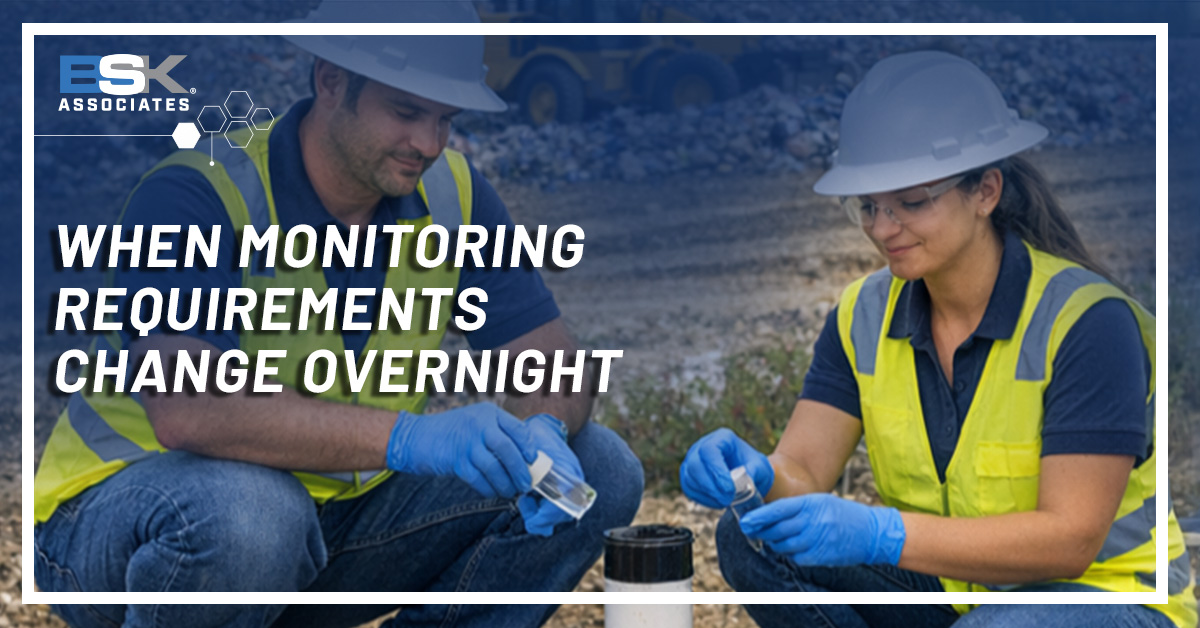
BSK Associates understands the weight of this responsibility, and we’re here to make this transition as efficient and stress-free as possible.  We’ve doubled our laboratory capacity for hexavalent chromium (Cr(VI)) testing using EPA Method 218.7—the gold standard for compliance monitoring.

This expansion means:

✅ Timely, reliable results that support your regulatory reporting schedules
✅ No capacity constraints when statewide demand surges as deadlines approach
✅ Uninterrupted compliance efforts so you can focus on serving your community 

Why BSK Associates For Your Hexavalent Chromium Testing in California 

When you partner with BSK Associates, you’re not just getting a lab—you’re getting a team that truly understands your challenges:

🔬 Accredited, accurate testing you can depend on for regulatory compliance
📅 Capacity to handle your sampling needs without delays or bottlenecks
🧠 Years of experience navigating California’s evolving water quality regulations
🤝 Excellent customer service that treats your challenges as our own
💡 Knowledgeable support to help you plan sampling strategies and stay ahead of deadlines

Take Action Now: Plan Ahead to Protect Your Community

Don’t wait until the deadline is looming. Water systems that plan their sampling well in advance will avoid capacity constraints and ensure seamless compliance.  BSK Associates is committed to supporting your compliance efforts and California’s public health objectives. We know this is a new challenge, but you don’t have to face it alone.

Ready to ensure your water system stays compliant and your community stays protected?

👉 Contact BSK Associates today to discuss your hexavalent chromium testing needs and discover how our expanded capacity can support your success. Why not give us a try? Let’s work together to turn this regulatory challenge into an opportunity to demonstrate your commitment to public health. BSK Associates – Your Partner in Water Quality Compliance


https://www.bskassociates.com/wp-content/uploads/2026/05/1200-x-628-WordPress-Blog.png 628 1200 Mikael Kourinian /wp-content/uploads/2026/07/bsk-logo-60.png Mikael Kourinian2026-05-20 11:00:042026-05-20 11:00:04Hexavalent Chromium Testing in California
Q1 Corporate Sponsorship Supports San Ramon FC 

Building Community Through Purpose: BSK Associates’ Q1 Corporate Sponsorship Supports San Ramon FC

May 15, 2026/in News/by Mikael Kourinian

Building Community Through Purpose – Q1 Corporate Sponsorship Supports San Ramon FC 

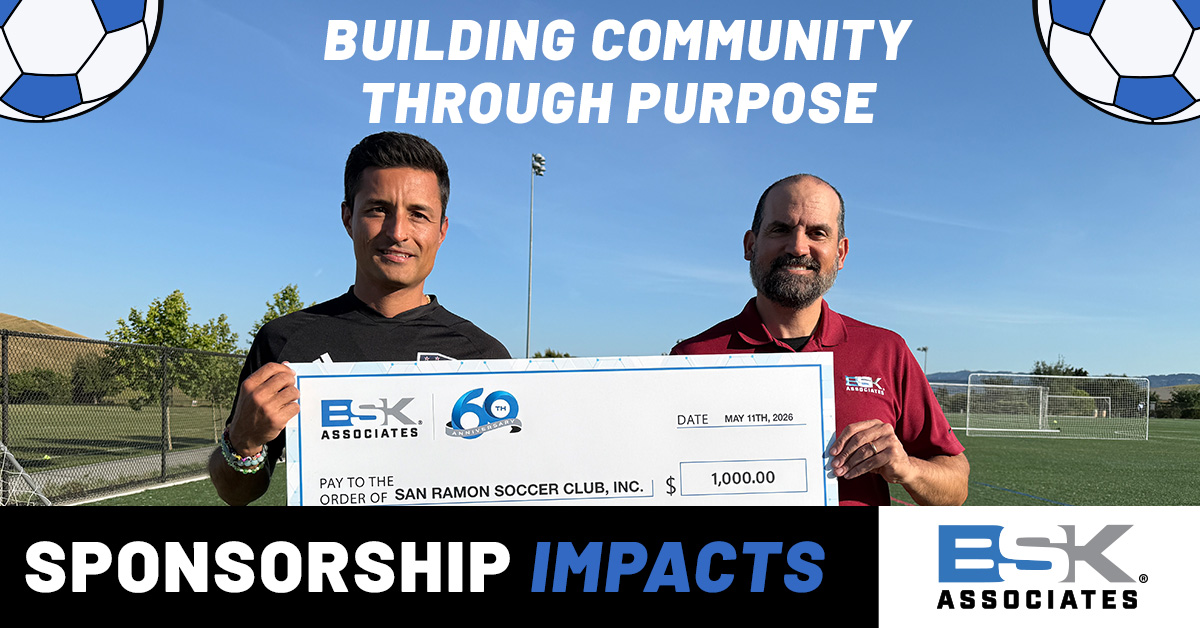
Q1 Corporate Sponsorship Supports San Ramon FC.  BSK Associates, community impact is not just a value—it is a commitment brought to life through meaningful action. As part of the company’s ongoing Corporate Sponsorship Program, BSK Associates is proud to announce its Q1 2026 recipient: San Ramon Soccer Club (San Ramon FC), nominated by Cristiano Melo, PE, GE and Managing Principal at BSK Associates. In support of this impactful organization, BSK Associates has awarded a $1,000 sponsorship check to further the club’s mission of developing players, character, and community through the sport of soccer.

A Personal Connection Driving Community Impact

San Ramon FC holds a special place in Cristiano Melo’s life, not only as a community organization, but as a deeply personal part of his family’s journey. Cristiano’s three children began their soccer experience with the club as recreational players around the age of six. Over the years, the organization has played a meaningful role in their growth—both on and off the field. Beyond athletic development, San Ramon FC has fostered lasting friendships, strengthened teamwork, and helped instill valuable life skills that extend well beyond the game.

Employee Involvement That Strengthens Communities

Cristiano’s involvement with San Ramon FC reflects a shared commitment to giving back. Throughout the years, Cristiano has dedicated time and effort to supporting the club in multiple capacities, including serving as a recreational coach and officiating matches as a referee. Today, as his children compete at a more advanced level under professional coaching, Cristiano continues his involvement as an Events Coordinator, organizing team gatherings that strengthen connections between players and families. His continued engagement highlights the strong culture of participation and community that defines San Ramon FC.

San Ramon FC’s Legacy of Excellence and Development

Founded in 1973, San Ramon FC is a non-profit soccer club based in San Ramon, California, serving the San Francisco Bay Area. For more than 50 years, the club has been committed to developing young athletes not only as soccer players but as individuals of strong character. The club’s programming is guided by 11 pillars of character, which are thoughtfully integrated into its curriculum to support personal growth, accountability, and leadership development among its players.

San Ramon FC’s reputation for excellence extends beyond its local community. The organization is among a select group of clubs nationwide to receive the prestigious “Players First” designation from US Club Soccer—an honor that recognizes a player-centered approach to development. This distinction reflects the club’s commitment to prioritizing the holistic experience of every athlete, ensuring that growth, well-being, and enjoyment remain at the core of its programs.

Building Pathways from Youth Soccer to Elite Competition

The club’s impact can also be seen in its history of developing talent at the highest levels. San Ramon FC has produced athletes who have gone on to compete in collegiate soccer across NCAA Division I, II, III, and NAIA programs. In addition, the club has supported players selected for Olympic Development Programs at the district, state, regional, and national levels. Notably, some former players have reached the professional stage, including individuals who have earned Olympic gold medals and competed as FIFA Women’s World Cup champions.

San Ramon FC’s offerings extend far beyond youth development. The organization provides competitive, pre-professional opportunities through men’s and women’s teams—making it one of the few clubs in the Bay Area to support athlete progression at multiple stages of play. This comprehensive structure allows players to envision a pathway for continued growth, whether pursuing collegiate, professional, or lifelong recreational soccer.

More Than a Club—A Lasting Community

One of the most defining characteristics of San Ramon FC is its enduring sense of community. Many former players return to the organization as coaches, volunteers, referees, and leaders, reinforcing a cycle of mentorship and giving back. This ongoing involvement has helped cultivate a vibrant, inclusive environment often described as “more than a club.” It is a place where relationships are built, values are reinforced, and individuals remain connected long after their playing days.

As a registered 501(c)(3) nonprofit organization, San Ramon Soccer, Inc. operates with a mission grounded in educational, charitable, and developmental goals. Every initiative is designed to enrich the lives of participants while strengthening the broader community.

Through the BSK Associates’ Q1 Corporate Sponsorship Supports San Ramon FC, proud to support San Ramon FC’s ongoing efforts and the meaningful impact it delivers. By investing in organizations that prioritize youth development, character building, and community connection, BSK Associates continues to reinforce its commitment to creating positive, lasting change.

Cristiano Melo’s nomination underscores the power of personal connection and community engagement—values that align closely with BSK Associates’ broader mission. As the Corporate Sponsorship Program continues throughout the year, BSK Associates looks forward to recognizing and supporting additional organizations that make a difference in the communities where its employees live and work.

Together, these efforts reflect a shared belief: when we invest in people, we strengthen communities.

https://www.bskassociates.com/wp-content/uploads/2026/05/1200-x-628-BLOG_WORDPRESS.jpg 628 1200 Mikael Kourinian /wp-content/uploads/2026/07/bsk-logo-60.png Mikael Kourinian2026-05-15 07:40:022026-05-15 07:40:02Building Community Through Purpose: BSK Associates’ Q1 Corporate Sponsorship Supports San Ramon FC
Preliminary Environmental Assessment for School Sites

Preliminary Environmental Assessment For School Sites

May 6, 2026/in News/by Mikael Kourinian

Children are uniquely vulnerable to environmental hazards, which is why California law requires state oversight to ensure school properties are safe for students, staff, and surrounding communities before they are purchased, developed, or occupied.  To help support Preliminary Environmental Assessment for School Sites, a Preliminary Environmental Assessment (PEA) is used to provide information if there has been a release of a hazardous substance at a potential school site that presents a risk to human health or the environment. This process plays a critical role in protecting public health, ensuring regulatory compliance, and managing environmental risk associated with school development.

Purpose of a Preliminary Environmental Assessment For School Sites

The primary purpose of a PEA is to provide DTSC with sufficient information to make an informed regulatory determination. Based on the findings, DTSC may conclude that a proposed school site requires no further action or may require the site to proceed into additional investigation or remediation under California’s hazardous waste and site cleanup programs. This authority is rooted in statutory mandates, public health protection, and risk-based environmental regulation.

Core Objectives of a DTSC PEA

  1. Determine Whether a Hazardous Substance Release Has Occurred

A fundamental objective of the PEA is to evaluate whether hazardous substances or petroleum products have been released at the site. This evaluation relies on available environmental data and, when necessary, limited sampling to confirm site conditions. The assessment also considers whether any identified release is associated with current or historical site activities.

This determination is essential to DTSC’s authority under California Health and Safety Code §25319.5, which governs DTSC’s ability to require further investigation or corrective action. Establishing the presence or absence of a release provides the foundation for all subsequent regulatory decisions.

  1. Evaluate Potential Risk to Human Health and the Environment

Another central purpose of the PEA is to assess whether any identified or suspected release could pose a risk to human health or the environment. This includes evaluating potential exposure to people, ecological receptors, and sensitive populations such as children.

The risk evaluation considers current and reasonably anticipated future land use and focuses on key exposure pathways, including soil, groundwater, soil vapor, surface water, and air. The PEA also evaluates current and future receptors and compares findings to DTSC screening-level risk criteria. This risk-based approach ensures that sites are evaluated consistently and conservatively to protect public health.

  1. Support DTSC Decision-Making on Next Steps

Based on the PEA findings, DTSC may issue several types of regulatory determinations. These may include a No Further Action (NFA) determination if no unacceptable risk is identified. In other cases, DTSC may require a Supplemental Site Investigation (SSI) or Remedial Investigation (RI) to further characterize site conditions.

DTSC may also determine that institutional controls, such as a land use covenant, are necessary or may enter the site into DTSC’s formal cleanup process. These outcomes ensure that regulatory oversight and resources are focused on sites that warrant further attention, while allowing suitable sites to proceed without unnecessary delay.

How a Preliminary Environmental Assessment for School Sites Fits into DTSC’s Cleanup Framework

DTSC considers the PEA an early but critical step in the site assessment and cleanup framework. It serves as a bridge between initial environmental due diligence and more comprehensive remedial investigation and response actions. The PEA is intentionally designed to be efficient, risk-focused, and protective of public health and the environment, particularly for sensitive land uses such as schools.

To learn more about Preliminary Environmental Assessments for School Sites and how BSK Associates can help support your business or institution, contact Kevin Grove, Managing Principal – Environmental Services.


https://www.bskassociates.com/wp-content/uploads/2026/05/1200-x-628_WORDPRESS-BLOG.jpg 628 1200 Mikael Kourinian /wp-content/uploads/2026/07/bsk-logo-60.png Mikael Kourinian2026-05-06 08:47:422026-05-06 08:47:42Preliminary Environmental Assessment For School Sites
Red Flags In Contract Language

Red Flags in Contract Language

April 22, 2026/in News/by Mikael Kourinian

Red flags in contract language are rarely why got into the geoprofessions.  Most of us got into the geoprofessions because we love the work.  Something about the field investigations, the problem-solving, and the satisfaction of helping a project get built safely. Not to mention it might just be what a lot of us went to school for. But for most of us, reading contracts was not a big part of our education, and I’m probably not going out on a limb saying it’s unlikely to be a significant contributor to why we enjoy the work! But knowing what is in a contract before you sign it may be one of the most important skills a working geoprofessional can develop.

This article is the first in a series that is intended to help project managers, senior staff, and anyone who touches a consulting agreement understand the language that can quietly create real problems for your firm. Learning to identify Red Flags in Contract Language is a practical skill that can protect both your projects and your business over the long term.

The unfortunate, but honest truth about consulting contracts is that they are rarely written with your firm’s interests as the top priority. Understandably, clients and their legal teams draft agreements that protect their side of the table. But it means that we need to read agreements carefully, ask questions, and occasionally push back. Not because we are looking for a fight, but because we cannot do the good work our clients expect of us if we are exposed to risks that no project budget, or insurance policy for that matter, was designed to cover.  Many of those risks stem directly from overlooked Red Flags in Contract Language.

Let’s review a few phrases and concepts that are worth being very aware of.

Red flag in contract language #1 – “Alleged negligence”

Negligence, in legal terms, means that someone failed to meet a reasonable standard of care and that failure caused harm. Negligence is usually evaluated by a court or through a legal process before anyone is held responsible. “Alleged negligence” skips that step. The word “alleged” means someone simply has to say that negligence occurred. No proof. No legal finding. Just an accusation.

This is important because most professional liability insurance is designed to respond when negligence has actually been established, not when it has only been claimed. If a contract holds you responsible based on an allegation alone, your insurance may not respond at all. That means legal costs, settlements, or damages could come straight out of your firm’s pocket, regardless of whether you did something wrong. All based on a claim.

Maybe a better way to frame this is to think of it as the difference between being held responsible because a court said you were at fault, versus being held responsible because someone pointed a finger at you. There’s clearly a pretty big difference that shifts your stance in court from defending your firm to having to prove beyond a doubt that you are innocent. Alleged negligence places the burden of proof on anyone accused of negligence rather than requiring evidence against them.

So, what do you do? Keep your eye open for the word “alleged” near any language about negligence, liability, or indemnification, and push for wording that ties responsibility to negligence that has been factually determined or proven, not just claimed.  This is a classic example of how Red Flags in Contract Language can hide in plain sight.

Red flag in contract language #2 – “Threatened negligence”

This one takes the concept of alleged negligence and goes one step further. While a formal allegation typically involves a written legal claim, threatened negligence can be triggered by something as informal as a frustrated email, an escalated phone call, or an angry letter from a client or contractor who had a bad day. In other words, if someone even hints that they might hold you responsible for something before any formal process has started or before anything has been evaluated, you could already be on the hook under contract language that includes threatened negligence.

Anyone who has worked on a construction project knows that sometimes tempers can run hot, schedules can slip, scopes of work can creep, and people look for someone to blame. Contract language that creates financial exposure at the first sign of a threat puts your firm essentially in a no-win situation because the trigger is entirely outside your control.

So, what do you do? If you see language that reads “threats,” “demands,” or “claims” in the same breath as negligence, you need to red flag it. Also, you should make a habit of carefully documenting your project communications. Chances are that if something sounds like a threat, even informally, it could be one. So be sure to let your project principal or leadership know right away.

Red flag in contract language #3 – “Without limitation”

This one can be easy to miss because it sounds almost reasonable. We will be responsible “without limitation” sounds like a commitment to doing a good job. But in a contract, “without limitation” has a very specific and very significant meaning – and it is one of the more dangerous Red Flags in Contract Language if left unchecked.

Many consulting agreements include provisions that cap certain types of costs in the event of a dispute. This is very common with things like attorneys’ fees, where ceilings exist because legal disputes can be extraordinarily expensive, and without some kind of guardrail, a disagreement over a small project can generate legal bills that far exceed the value of the work itself.

“Without limitation” removes that ceiling entirely. It means that if a dispute ends up in litigation, attorney’s fees for everyone involved could go as high as the lawyers take them, and your firm would be exposed to whatever that figure turns out to be. In a long or complicated dispute, that number can be exceptionally large and will often end with the lawyers as the only winners.

So, what do you do? Look for “without limitation” anywhere near language about fees, costs, or damages. A reasonable alternative is to propose a cap on reasonable attorney’s fees that is tied to the value of the contract or your professional liability limits. You’re looking for something that keeps the exposure proportional to the value of your services to the actual project.

Red flag in contract language #4 – Consequential and incidental damages

Consequential and incidental damages should be thought of as the difference between fixing a problem and dealing with everything that flows from it. To start, let’s try to define what each of these is with an example: A water pump breaks at a manufacturing plant, requiring a corrective response.

Incidental Damages (The “Clean-up” Costs)

Example: Because the water pump broke, the client had to pay their own maintenance staff overtime to mop up the leaked water, and they had to pay a rush-delivery fee to get a replacement pump shipped overnight. Those extra administrative and clean-up costs are incidental damages. This is the effort to correct the direct and immediate impact of the incident, and likely could be estimated or predicted with some level of certainty as a potential risk associated with the situation.

Consequential Damages (The “Ripple Effect” Costs)

Example: Because the water pump broke, the client’s manufacturing plant had to shut down for 48 hours. They couldn’t produce their goods, resulting in $500,000 in lost sales. That massive loss of revenue is a consequential damage These are costs that, while a consequence of the event, could not be defined or predicted with certainty as a result of the associated situation.

Putting these into geoprofessional terms, imagine a scenario in which a geotechnical recommendation is disputed, and a client claims it caused a delay on their project. Without a clear exclusion in the contract, your firm could be held responsible for the entire ripple effect—one of the most costly Red Flags in Contract Language you can encounter.  The direct cost of addressing the geotechnical issue, which might include revisiting the analysis or issuing a revised recommendation, is one thing. But what about the contractor who was sitting idle while the delay played out? The lost revenue that the developer claims they would have earned? The costs of every other subcontractor whose schedule was affected? Those downstream effects are what we mean by consequential and incidental damages.

Without a clear exclusion in the contract, your firm could be held responsible not just for the direct issue but for the entire ripple effect. That kind of exposure has almost nothing to do with the actual scope or fee of your work and is very difficult to anticipate or insure against in advance. Standard practice in professional consulting is for both parties to agree up front that neither side will seek consequential or incidental damages from the other. This is fair, common, and protects everyone at the table.

So, what do you do? Check whether the contract includes a mutual waiver of consequential, incidental, indirect, and punitive damages. If it does not, that absence is itself a red flag. Propose adding one and frame it as mutual protection for both parties, which it absolutely is. A large majority of contracts will include a waiver of consequential or incidental damages for the client alone, which can easily be negotiated to become a mutual waiver. So that’s an opportunity that you should try to work toward.

One more: the calendar days assumption

This one is short, but it catches people off guard more often than it should. When a contract refers to “days”, as is often the case for a deliverable deadline, a notice period, or a review window, it needs to specify what kind of days. The law generally treats days as calendar days, not business days. Every day of the week, including weekends and holidays.

The difference matters more than it might seem. A 10-day turnaround that lands over a holiday weekend is suddenly a much tighter window than you planned for. A 30-day deliverable schedule that includes two weeks of holidays is not the schedule your team budgeted around. A 3-day requirement to resolve a problem in many cases would leave you without any chance for resolution if the notification was received late on a Friday ahead of a 3-day holiday weekend.

If you mean business days, and most of the time that is what we mean, the contract needs to say business days every time it comes up. Do not assume the other side reads it the same way you do, because the default assumption will not be in your favor. Make sure you ask the question, get clarification, and get the contract amended.

The Bottom Line

None of this requires a law degree. It requires slowing down at the contract stage and evaluating the agreement —specifically watching for Red Flags in Contract Language that seem harmless at first glance.  Even when the project feels routine, the client is familiar, or the pressure to get started is mounting. The clauses that create the most trouble are almost always the ones that seemed fine at a quick glance or maybe were inadvertently accepted before.

When something looks unusual, ask about it. Most clients are reasonable, and many contract issues can be resolved simply by raising them early and proposing fair alternative language. From my perspective, this is key!  If you are requesting an adjustment to their agreement, propose one or more reasonable alternatives for consideration, along with an explanation of why you are making the amendment request. Your goal is to eliminate the challenges in the client’s review and acceptance of the change, so put it right in front of them and do the frontline work to get it pushed through. Make a phone call to discuss it, draft a detailed Email addressing your concerns and requests, but be sure you are proactively and energetically engaging in the discussion. The goal is never to be difficult, but to make sure both sides understand what they are agreeing to and that it is reasonable for the work being performed.

In Part 2 of this series, we will turn from the contract itself to the insurance coverage behind it, exploring what insurance policies actually protect, where the gaps are, and why understanding your own coverage matters just as much as reading the contract in front of you. So, until then, keep your eyes open for those red flags!  You’ll be glad you did!

Check our website, BSK Associates to learn more about our work and what we do and if you would like to connect with one of our talented associates, please click on the link to schedule a meeting opportunity
https://www.bskassociates.com/wp-content/uploads/2026/04/1200-x-628-Word-Press.jpg 628 1200 Mikael Kourinian /wp-content/uploads/2026/07/bsk-logo-60.png Mikael Kourinian2026-04-22 09:37:482026-04-22 09:37:48Red Flags in Contract Language
communication in geoprofessional practice

Communication in the Geoprofessional Practice

March 26, 2026/in News/by bskassociates

Communication in the geoprofessional practice is key.  In the geoprofessional disciplines, we spend a great deal of time talking about risk. We analyze it, model it, mitigate it, and sometimes debate it over long tables filled with contract language, reports, drawings, figures, and coffee cups. The geotechnical engineering discipline provides designs that involve a lot of uncertainty, often with very limited information, to help clients move projects forward with confidence.

Yet one of the most effective risk management tools we have doesn’t appear in a soil log, a field report, a laboratory test result, or a design calculation.

It’s communication.

Not the kind of communication that shows up only at the end of a project report, but the kind that happens throughout a project.  The kind that happens between team members, with clients, and among all the stakeholders working together to turn a plan on paper into a successful real-world project.

In many ways, communication in the geoprofessional practice is the glue that holds the geoprofessional practice together. When it works well, projects tend to run smoothly. When it doesn’t, even the best technical work might not be enough to avoid problems.

Let’s take a few minutes to discuss some high-level communication considerations.

Communication in the Geoprofessional Practice – a Risk Management Tool

Geoprofessional consulting involves navigating some level of uncertainty. Subsurface conditions are inherently variable, and our work often requires interpreting limited data to provide practical recommendations. For example, geotechnical investigation and environmental samples are small representations of a much larger whole. Inspection and testing reports are limited to the specific items we observed and were present for. Because of that reality, effective communication becomes a form of risk management.

When we communicate clearly about what we know, what we don’t know, and how we reached our conclusions, we help clients make informed decisions. More importantly, we help set appropriate expectations for how conditions may evolve during construction.

Proactive communication, especially early in a project, often prevents small misunderstandings from becoming larger issues later. A brief conversation today about any project concern or potential issue can save days or weeks of confusion later and even save clients or your firm a lot of money.

Anyone who has been in this business for a while might have heard that surprises are expensive. Part of our job is to help minimize surprises, whether through proposals, project planning, geotechnical investigations, environmental reviews and evaluations, materials test results, or special inspection reports. In geoprofessional work, many surprises can be avoided, or at least softened, through clear and timely communication.


WANT TO LEARN HOW BSK ASSOCIATES IS ABLE TO HELP YOU WITH GEOPROFESSIONAL SERVICES?

WATCH OUR LATEST PODCAST

Communicating Uncertainty

One of the most important responsibilities in our profession is communicating uncertainty and limitations. That can feel like a delicate balance. On one hand, we want to provide clear guidance and recommendations. On the other we must acknowledge the natural variability inherent to our professions.

But good communication doesn’t weaken our recommendations; it strengthens them.

When we explain the basis of our observations, findings, conclusions, the assumptions involved, and the potential variability in any conditions, we give project teams the context they need to make better decisions. Transparency builds trust, and trust is one of the most valuable currencies in any professional relationship. Clients and project teams typically have at least a loose understanding of the complex services we provide. But what they appreciate most (at least the good ones) is clarity about what our data indicates, what any potential risks are, and how those risks can be managed or mitigated. In other words, honesty and transparency rarely create problems, but silence and ambiguity sometimes do.

Internal Communication is the First Step

For many geoprofessionals, the first thought about communication might be directed toward clients and project partners. We should remember that effective internal communication is just as important.

Geoprofessional projects often involve collaboration across multiple disciplines. This can include field personnel, laboratory technicians, project managers, engineers and geologists, inspectors, and administrative teams. Each of these groups contributes essential information that helps shape project decisions. When information flows smoothly between these team members, projects benefit from a fuller understanding of conditions and progress. Observations made in the field can quickly inform engineering decisions. Laboratory results can refine interpretations. Project managers can keep clients informed and aligned with mutual expectations.

When internal communication breaks down, valuable information may remain isolated within a single part of the project team or even with a single individual. That can create a missed opportunity to address issues early or to provide clients with relevant information that, if delivered on time, can have a significant impact or cost implications.  The bottom line is that strong external communication frequently begins with strong internal communication.

The Value of Early Conversations

One of the simplest but most effective communication strategies is often overlooked: TALK EARLY!

Early communication has many forms. It could be:

  • A quick call before mobilization to discuss project expectations or special requirements.
  • A brief meeting to review how reports or findings will be communicated during construction.
  • A conversation about how potential subsurface variability, a failing test result, or a non-conformance might affect the project schedule or next steps.

Early discussions help align teams (both internal and external) and establish a shared understanding of the project’s goals and potential challenges. They also reinforce the collaborative nature of successful projects, which should be everyone’s common goal.

Early communications also open doors for future conversation and set a tone for anyone involved in the project. When project teams feel comfortable having conversations or raising questions early, problems often become easier to solve. When those conversations happen late or not at all, solutions and resolutions can become much more complicated and can pose relationship-changing considerations, like whether you’re hired the next time. Timing matters in consulting.

Transparency Builds Stronger Teams

Clear and open communication also strengthens the working relationships that make projects successful. When teams communicate transparently by sharing information, raising concerns, and openly discussing potential risks, it fosters a culture of collaboration. Engineers, contractors, owners, and inspectors begin to see themselves not as separate parties, but as contributors to a shared outcome. That sense of teamwork is particularly valuable in complex projects where conditions develop quickly and the impact of timely decisions is magnified.

Transparent communication creates an environment where people are comfortable asking questions, offering observations, and working together to resolve challenges. In the long run, that environment benefits everyone involved in the project and, at its core, underpins good teamwork.

Communication Is Part of the Practice

In geoprofessional consulting, technical expertise will always be the foundation of our work and is, in large part, an expected skill set for any firm operating within our disciplines. But the value of that expertise depends on how effectively it is shared and understood.

Clear, proactive communication in the geoprofessional practice helps manage uncertainty, strengthen professional relationships, and support better decision-making throughout the life of a project. It also reinforces a fundamental aspect of our profession: part of our job is to help others understand what the information we derive from our work actually means.

When done well, communication becomes more than an administrative task. It becomes one of the most powerful tools we have for delivering successful projects and minimizing risk. And in geoprofessional practice, that makes it anything but underrated.


Reach out to BSK Associates to learn more about how we help client with Geoprofessional services.

https://www.bskassociates.com/wp-content/uploads/2026/03/1200-x-628-WORDPRESS-BLOG-1.jpg 628 1200 bskassociates /wp-content/uploads/2026/07/bsk-logo-60.png bskassociates2026-03-26 14:50:252026-03-26 14:50:25Communication in the Geoprofessional Practice

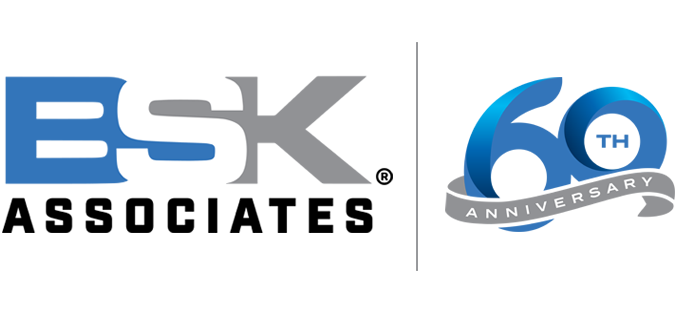
Phase I Environmental Site Assessment

March 3, 2026/in News/by bskassociates

A Phase I Environmental Site Assessment (ESA) is a critical component of environmental due diligence for anyone involved in the purchase, financing, or redevelopment of real property. Its primary purpose is to help clients understand potential environmental risks associated with a property before moving forward with a transaction. By identifying environmental concerns early, a Phase I ESA supports informed decision-making and helps protect clients from unexpected liabilities.

The assessment is conducted in accordance with ASTM E1527-21, the industry-recognized standard for Phase I Environmental Site Assessments. This standard establishes a consistent framework for evaluating environmental conditions and is widely accepted by lenders, investors, and regulatory agencies. A properly completed Phase I ESA is designed to identify any known or potential environmental conditions that could affect a property’s value, current or future use, financing, or redevelopment plans.

Establishes Liability Protection Under Federal Law with Phase I Environmental Site Assessment

One of the most important benefits of a Phase I ESA is the legal protection it can provide. When conducted in compliance with ASTM E1527 standards, a Phase I ESA helps purchasers, lenders, and property owners qualify for specific liability defenses under the Comprehensive Environmental Response, Compensation, and Liability Act (CERCLA), commonly known as the federal Superfund law.

These defenses include the “Innocent Landowner,” “Bona Fide Prospective Purchaser,” and “Contiguous Property Owner” protections. Qualifying for these defenses can shield clients from being held financially responsible for contamination that occurred prior to their ownership and was not caused by their actions. Without this protection, property owners may face significant cleanup obligations, potentially totaling millions of dollars, even if they did not contribute to the contamination.

Identifies Environmental Risks Before Money Is Committed 

A Phase I ESA evaluates whether Recognized Environmental Conditions (RECs) are present at the property. RECs are defined as the presence or likely presence of hazardous substances or petroleum products due to releases, past releases, or conditions that pose a material risk of a release.

Identifying these risks early allows clients to make strategic decisions while they still have leverage. Depending on the findings, a client may choose to avoid purchasing or financing a high-risk property altogether. Alternatively, the information may be used to renegotiate the purchase price, revise contract terms, or require corrective actions such as cleanup, escrow arrangements, or indemnifications from the seller. In cases where uncertainty remains, the Phase I ESA also helps determine whether further investigation, such as a Phase II ESA involving sampling and laboratory analysis, is warranted.

Limits Unexpected Financial Exposure 

Environmental issues can lead to a wide range of financial and operational challenges. These may include costly cleanup requirements, regulatory enforcement actions, construction delays, reduced property value, and difficulties with future sale or refinancing. Without proper due diligence, these issues often surface after acquisition, when options are limited and expenses are significantly higher.

A Phase I ESA helps limit this exposure by providing a clear understanding of potential environmental concerns before the transaction is finalized. Clients can better anticipate future costs, plan realistic budgets, and avoid “surprise” liabilities that could impact project timelines or financial performance.

Supporting Informed Business Decisions with Phase I Environmental Site Assessment

By reviewing historical property uses, regulatory databases, aerial photographs, and current site conditions, the Phase I ESA delivers clear, defensible information. This process enables clients to manage environmental liability responsibly and make confident business decisions based on documented findings rather than assumptions.

 In Simple Terms

A Phase I Environmental Site Assessment protects a client by:

  • Reducing legal liability
  • Preventing costly surprises
  • Preserving deal leverage
  • Supporting defensible, informed decisions

In today’s risk-conscious real estate and lending environment, a Phase I ESA is not just a formality—it is an essential tool for protecting investments and ensuring long-term success.  To learn more about Phase I Environmental Site Assessments and how BSK Associates can help support your business or institution, contact Kevin Grove, Managing Principal – Environmental Services.

https://www.bskassociates.com/wp-content/uploads/2026/03/1200x628-TEST.jpg 628 1200 bskassociates /wp-content/uploads/2026/07/bsk-logo-60.png bskassociates2026-03-03 15:18:372026-03-03 15:18:37Phase I Environmental Site Assessment

BSK Associates Announces Q4 2025 Corporate Sponsorship Winner and Selected Community Organization

February 19, 2026/in News/by bskassociates

BSK Associates Announces Q4 2025 Corporate Sponsorship Winner and Selected Community Organization

Fresno, CA — January 30, 2026 — BSK Associates is proud to announce the recipient of its Q4 2025 Corporate Sponsorship Award, an employee‑driven program that recognizes team members who actively support and uplift organizations making a meaningful difference in the community. The latest quarter’s honoree has chosen to direct the sponsorship funds to SCI-FIT, a highly respected rehabilitation center specializing in integrated therapies for individuals with spinal cord injuries and neurological trauma.

SCI-FIT has earned a distinguished reputation for its dedication to healing, recovery, and long-term wellness through innovative, client-focused rehabilitation programs. The organization provides intensive therapeutic services that are often not covered by insurance, forcing many families to pay out of pocket. Despite these challenges, SCI-FIT remains committed to offering high-quality care that is both compassionate and transformative.

The center’s owners and staff are widely recognized for creating a warm, family-like environment where clients feel supported, valued, and empowered. Their team regularly works with individuals and families experiencing some of the most difficult and emotional chapters of their lives. Through this, SCI-FIT maintains a spirit of optimism and encouragement, greeting each session with professionalism, positivity, and unwavering dedication. Their impact extends beyond the walls of their facility, as they actively engage with and contribute to the broader community.

The employee who selected SCI-FIT for this quarter’s sponsorship shared a deeply personal connection to the organization. Their daughter, who suffered a traumatic brain injury, has been attending SCI-FIT for over a year. As a non‑mobile patient, she participates in rehabilitation sessions twice weekly, focusing on stretching, balance, walking exercises, and a variety of targeted therapeutic workouts. These sessions have played a significant role in her ongoing development, offering essential physical progress as well as emotional support for both the patient and her family.

“The team at SCI-FIT treats us like family,” the employee noted. “Their kindness, expertise, and positivity have made an enormous difference—not just in my daughter’s rehabilitation, but in our lives as a whole. It means so much to be able to give back to an organization that gives so much every single day.”

BSK Associates’ Corporate Sponsorship Program reflects the company’s commitment to fostering a culture of compassion, social responsibility, and community collaboration. By empowering employees to nominate organizations that are personally meaningful to them, BSK ensures that its philanthropic efforts remain authentic, relevant, and deeply impactful.

BSK Associates looks forward to continuing its mission of uplifting organizations that inspire resilience, healing, and hope.

https://www.bskassociates.com/wp-content/uploads/2026/02/BLOG-POST-1200-x-628.jpg 628 1200 bskassociates /wp-content/uploads/2026/07/bsk-logo-60.png bskassociates2026-02-19 15:06:452026-02-19 15:06:45BSK Associates Announces Q4 2025 Corporate Sponsorship Winner and Selected Community Organization
Page 1 of 12123›»
  • BSK Associates Names Weldon Elementary Its Q2 2026 Sponsorship WinnerOctober 14, 2026 - 4:58 pm
  • Understanding Your Insurance CoverageJuly 6, 2026 - 6:00 am
  • RCRA Appendix IX Groundwater Monitoring
    RCRA Appendix IX Groundwater Monitoring: BSK Expands ServicesJune 19, 2026 - 8:26 am
  • Hexavalent Chromium Testing in California
    Hexavalent Chromium Testing in CaliforniaMay 20, 2026 - 11:00 am
  • Q1 Corporate Sponsorship Supports San Ramon FC 
    Building Community Through Purpose: BSK Associates’ Q1 Corporate Sponsorship Supports San Ramon FCMay 15, 2026 - 7:40 am
  • Preliminary Environmental Assessment for School Sites
    Preliminary Environmental Assessment For School SitesMay 6, 2026 - 8:47 am
  • Red Flags In Contract Language
    Red Flags in Contract LanguageApril 22, 2026 - 9:37 am
  • communication in geoprofessional practice
    Communication in the Geoprofessional PracticeMarch 26, 2026 - 2:50 pm
  • Phase I Environmental Site AssessmentMarch 3, 2026 - 3:18 pm
  • BSK Associates Announces Q4 2025 Corporate Sponsorship Winner and Selected Community OrganizationFebruary 19, 2026 - 3:06 pm
  • Taming the Time Management BeastJanuary 6, 2026 - 8:44 am
  • Unlock the Power of Biomass with Fast, Reliable Analytical TestingNovember 10, 2025 - 5:00 am
  • Renea Rangell to Deliver Keynote at ACIL Annual Meeting: Elevating Lab Leadership in 2025
    Renea Rangell to Deliver Keynote at ACIL Annual Meeting: Elevating Lab Leadership in 2025October 31, 2025 - 9:16 am
  • BSK Associates Announces 3rd Quarter Sponsorship of Kevvy’s Vision Project, Honoring Legacy of Community ServiceOctober 27, 2025 - 9:21 am
  • Why Testing Residential Well Water Is Crucial When Buying a HomeOctober 13, 2025 - 5:00 am
BSK Associates

(800) 669-3201

Corporate Headquarters

691 N. Laverne Ave. STE 101
Fresno, CA 93727
Local: (559) 497-2880

Hours of Operation

Monday – Friday 8 AM - 5 PM
Office hours vary by location

Subscribe to BSK PULSE

Thank you for signing up.
Please correct the marked field(s) below.
1,true,6,Contact Email,2 1,false,1,First Name,2 1,false,1,Last Name,2
Close
© 2026 Copyright BSK Associates | Accessibility |  NFY Interactive
  • Link to Facebook Link to Facebook Link to Facebook
  • Link to Instagram Link to Instagram Link to Instagram
  • Link to LinkedIn Link to LinkedIn Link to LinkedIn
  • Link to Youtube Link to Youtube Link to Youtube
Scroll to top Scroll to top Scroll to top