
Soil Compaction Testing
Soil Compaction Testing
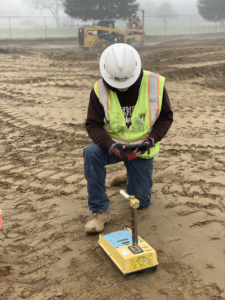
nuclear density gauge test
Soil Compaction Testing is a crucial step in the construction process. Ground that has not been properly compacted can be detrimental to the structural integrity of buildings, retaining structures, roads and pavements, just to name a few. Essentially, proper soil integrity could make or break your structure. Since soils are so critical to a structures reliability you will find that soil compaction testing is required most cases. For instance, most regulatory agencies such as, the Department of Transportation and American Society for Testing and Materials all require laboratory testing. Additionally, you will find that the California and Uniform Building Codes, the geotechnical engineer, and structural engineers will also require soil compaction testing.
Why Compaction Testing is Important
There is a very good reason for all the necessity. Basically, if soil tests are not conducted you risk shifting, cracking, and even the collapse of your building. Roadways could also result in disaster by cracking, sagging, potholes, or even sinkholes. In the end, it’s vital for the success of your structure to ensure you have reliable soil compaction testing. Moreover, having a company that has a seasoned and knowledgeable staff, as well as testing facility, is critical. Not only will a more experienced staff save you time, it will also save you money.
How soil Compaction Testing Works
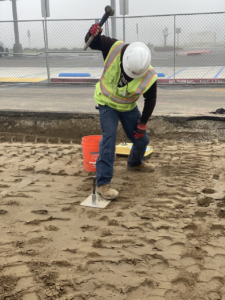
A soil compaction test begins with samples. After excavation a field technician will collect soil samples. An experienced field technician will gather samples from several locations to attain representative samples of various soil types that may be on site. Each soil type, or mixture thereof, has different properties and can act in different ways. A skilled lab technician will be able to recognize the potential properties of each, and be able to determine best spots for soil extraction. It can also be valuable to take a sample from the stockpile. This is usually done if the technician notices that the stockpile soil has different properties than the other site soil, or because several soil types are being blended together.
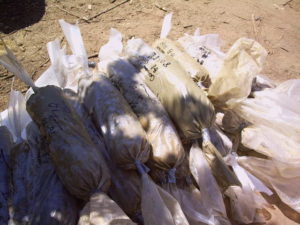
Once at the laboratory the process of determining the optimum moisture content and maximum dry density will occur. A lab technician will start by sifting and moisture conditioning of the soil. Once the soil is prepped the soil will go into a cylindrical mold to be compacted at various moisture contents and weighted.
The test is to see how much of the material can be compacted into the same volume at the various amounts of moisture. When a material is too dry it can not compress very tightly. As more water is added, it is able to compact in better and better, so it’s dry density (unit weight calculated removing the water weight) is increased. Once it hits the limit that the material will allow, the water starts displacing the material and the dry density will start dropping, creating a “curve”. The peak of this “curve” is considered the maximum dry density and the optimum moisture for that specific material. Again, it is of vital importance to have an experienced lab for this process.
Nuclear Gauge Testing
The last key step in soil compaction testing involves the use of a soils nuclear gauge. Back at the job site, a field technician uses a nuclear gauge that has two radioactive isotopes (roughly the same mass as the head of a pin), and emits extremely small amounts of radiation into the soil. Inside of the machine there are sensors that detect how much of the radiation makes it back to the machine. One of the sources is for detecting the hydrogen content, which is a direct correlation with the moisture content. The other source is for detecting the wet density.
Using both of these readings, the nuclear gauge calculates the in-place dry density. This number is compared to the maximum dry density that was determined by the lab testing and is expressed in the form of a percentage. Typical requirements are between 90% and 95% of the maximum dry density. If the material changes even slightly, it could drastically affect the results indicating failure. An experienced field technician will notice the change and pull another sample for a curve rather than have the contractor keep trying to work the material wasting time and money.
To find out more about soil compaction requirements in California click here.
Why BSK Associates
Soil Compaction Testing
As mentioned previously, having seasoned field and laboratory technician is key in this process. BSK Associates has been in the industry for over 53 years. Our history in the industry ensures that our clients receives accurate results in a timely manner. We are a dedicated team focused on developing practical, cost-effective solutions for our clients, and working toward constant improvement within our profession.
Follow Us and Like Us
BSK strongly believes in giving back to the communities in which we work. We make sure our community involvement goals have a positive impact on the communities which we serve; because, in the end it’s all about community.
Want to be in the “know” on upcoming BSK events, community service, and projects?
Like us on Facebook.
Follow us on LinkedIn and Twitter.
Have a question about the services we offer? Check out our webpage @bskassociates.com.
Looking for a Great Places to Work? You’ve found it! We are proud to be Great Place to Work certified. Check out our job opportunities page for more details.